Showing posts with label fish. Show all posts

Fisherman Catches 1,000 Strange Species of Fish


47 -year-old Steve Wozniak, a lure fisherman from California, has traveled the world over, in his quest to catch as many different species of fish as possible. So far he managed to catch 1,000 species, from a colorful Threadfin Butterflyfish to a 410 kilogram shark.
  Believe it or not, Steve Wozniak has spent the last 10 years, and $75,000 traveling to 63 different countries in the search for new species of fish to put on his list. He flew over 1 million air miles, and spent over 20,000 hours holding his trusty rod and hoping for a bite. But all his efforts paid out when he finally caught his 1,000th fish species, a Norwegian coalfish, and set a new world record.

Strange Puffer Fish


Puffer fish are generally believed to be the second–most poisonous vertebrate in the world, after the Golden Poison Frog. The skin and certain internal organs of many tetraodontidae are highly toxic to humans, but nevertheless the meat of some species is considered a delicacy in both Japan (as fugu) and Korea (as bok-uh). If one is caught while fishing, it is recommended that thick gloves are worn to avoid poisoning and getting bitten when removing the hook.
The puffers's unique and distinctive natural defenses are a compensation for their particular form of locomotion. Puffers use a combination of pectoral, dorsal, anal, and caudal fins for propulsion that make them highly maneuverable but very slow, and therefore comparatively easy targets for predators. As a defense mechanism, puffers have the ability to inflate rapidly, filling their extremely elastic stomachs with water (or air when outside the water) until they are almost spherical in shape. Thus, a hungry predator stalking the puffers may suddenly find itself facing what seems to be a much larger fish and pause, giving the puffers an opportunity to retreat to safety.

Strange and Ugly Monstrous Fish

"Why are the Earth's oceans more mysterious to us than the Moon?"
- Bill Bryson, "A Short History of Nearly Everything"

It's commonly said we know more about the surface of the moon than we know about what happens right here on our own planet, in that murky world at the bottom of the sea. And indeed, we have only explored less than 5 percent of our oceans (we have better maps of Mars than we do of the ocean floor!)


Here's a fun fact for you: did you know that you, an unprotected human being, can last for about two whole minutes in a vacuum -- say on the surface of the moon? Here's another amusing bit of knowledge: did you also know that you, still just an unprotected homo sapiens, would last only the barest smidgen of a second before being totally, completely pulped by the crushing pressures at the bottom of the sea?

There is also more light on the dark side of the moon than there is down, down, down in those ocean depths... One thing we do know, though: even in the deepest part of the ocean, the Challenger Deep in the Mariana Trench, despite the crushing pressure (at least 16,000 pounds per square inch) and the absolute, total, complete darkness, there is life. Auguste Piccard, who made an adventurous trip in 1960 to the bottom of the Deep in his bathyscaphe, the Trieste, saw a few extreme creatures that managed to made that extreme environment their home.

The Fangtooth Fish lives at depths of more than 5,000 meters:


While not as deep – but just as dark – as the Deep, scientists have found, and continue to find, an amazing, and sometimes nightmarish, world of creatures in the abyssal plains, which make up more than a staggering 50% of the earth's surface.


Light is so rare down there that its uniqueness is an allure, for mating, as well as a lure, for eating. Grammatostomias flagellibarba, 'dragon fish' to you and I, uses bioluminescence – biological light – mainly for the latter: EATING. Any deep, deep, deep swimmer that notices and becomes interested in a certain tiny flickering light will end up becoming caught by the dragon fish's monstrously huge and needle-sharp toothed mouth. The light being a glowing lure at the end of a long, thin filament connected to the underside of the fish's jaw:


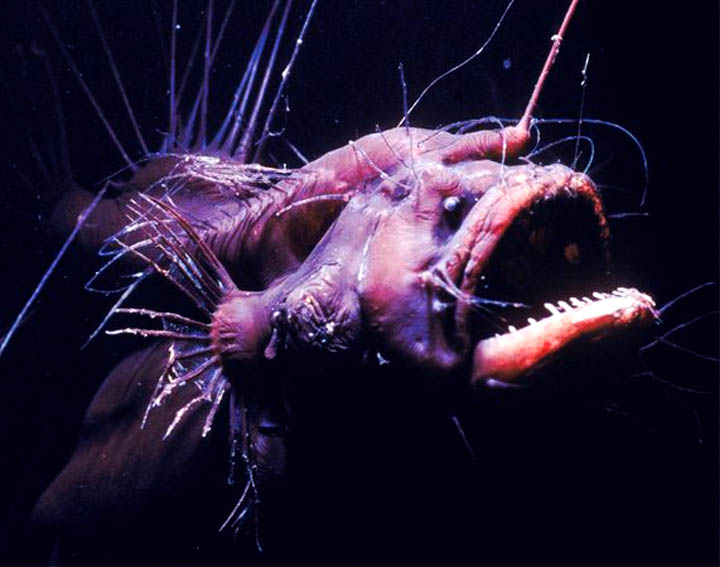
The sea angler uses a similar trick, though it's more globular instead of having the dragon fish's lean and nasty body. The angler's lure has the same function, but a different location: its flashing trick is a kind of deadly finger between its eyes and its similarly sharp-toothed mouth rather than being at the end of a thin strand like the dragon fish.

Found two kilometers beneath the Coral Sea, off the shores of Australia - the Hairy Anglerfish: "The long hairs of the anglerfish carry sensory information to the fish's brain":


The "Longhead Dreamer" anglerfish (Chaenophryne longiceps) was found in waters near Greenland


The Bathysaurus, or deep sea lizardfish, can and will bite with any opportunity. It's also a half-a-meter long:


Yet another contender for the oddly pretty prize is the so-called barreleye. This fish takes vision to a new level of spooky strange. Sure, it has eyes, but instead of having to deal with an oh-so-annoying skull that gets in the way of what it's trying to see, the barreleye's head is transparent: to look up it just moves its eyes to focus through its clear – and a bit disturbing – cranium.


Atolla & Periphilla Jellyfish:


A see-through sea cucumber, Enypniastes, was spotted at depths of about 1.7 miles (2.7 kilometers). It lives in the northern Gulf of Mexico, at depths of 2.7 kilometers (bottom left). On the right is "Dumbo" - with ridiculously big "ears":


The Ping Pong Tree Sponge is one of the family of carnivorous demosponges (I bet you read "Demon-sponges, didn't you?) and is pretty big, at least half a meter in height.


The granrojo (above right) is not hooked or spiked, but this deep-water jellyfish is just as odd, with chubby arms and an almost plastic looking crimson bell.

While neither of these fish and jellies – and there are far too many to name here – are monsters in size, there is something called abyssal gigantism, the tendency for other forms of extremely deep-dwelling organisms to not only be odd, strange, bizarre and darned creepy but also – yes, you guessed it – HUGE.

Do you have a small dog, a cat, or a larger-than-average tortoise? How would you like to have a pet the size of any of them but isn't just from a different species but from a whole different phylum?


Cute? Not really. Cuddly? Absolutely not. But the giant isopod would certainly be a conversation starter if you took it out for a walk: imagine a pill bug weighing over four pounds.

Other abyssal giants include the poster child for arachnophobia, the Japanese spider crab, which averages 12 feet from leg to creepy leg; and then there's the giant ... well, we'll get to him in a minute.


Vampire Sea Spider from Antarctica? Sounds like something from H.P.Lovecraft's "At the Mountains of Madness", but it is a real creature, not a fantasy

Awesome and Huge jellyfish Nomura sank the Japanese fishing ship

Nomura’s jellyfish is a very large Japanese jellyfish. It is in the same size class as the lion’s mane jellyfish, the largest cnidarian in the world. The diameter of these jellyfish is slightly greater than the height of an average fully grown man.

It grows 2 meters (6 feet 7 inches) in diameter and weighing up to 220 kg (about 450 pounds), Nomura’s jellyfish live principally in the waters between China and Japan, mainly in the central Yellow Sea and East China Sea
Nomura’s jellyfish has plagued the seas of Japan from 2005 up to the present. The unintentional attacks brought by this kind of creatures have severed the fishing industries of the affected regions in Japan as well as the balanced food chains in the seas.

Japanese fishing trawler sunk by giant jellyfish, A 10-ton fishing boat has been sunk by gigantic jellyfish off eastern Japan. Trawler, Diasan Shinsho-Maru, was killed off Chiba “the three-person crew and tried to trip a net containing dozens of huge Nomura’s jellyfish.

Each jellyfish can weigh up to 200 kg, and the waters around Japan, has been flooded with creatures of this year. Experts believe, the weather and water conditions for the growth of the coast of China, it is ideal for jellyfish in recent months.

The crew of the fishing vessel were thrown into the sea when the ship crashed, three men were rescued but another trawler the Mainichi newspaper. The local Coast Guard office announced that the weather was clear and the sea was calm about the accident.

The last time Japan took a very large, in the summer of 2005, jellyfish nets damaged, rendered the fish inedible to poisonous bites, and even cause injury to the fishermen.Relatively little is known about Nomura’s jellyfish, such as why some years see thousands of creatures floating in the sea over the Japanese Tsushima Current, but last year there was virtually no sightings. In 2007 were 15,500 reports of damage to fishing equipment, from creatures.

10 Amazing Nat Geo Discoveries of 2009

National Geographic News’s most popular coverage of 2009 scientific finds is swarming with megamouth sharks, giant snakes, a transparent-headed fish, “Jacques Cousteau” clouds , and rare species rescued from obscurity—then eaten.

Top 10 National Geographic Discoveries of 2009

10. Ultra-Rare Megamouth Shark Found, Eaten
In March, the 41st megamouth shark ever found went from swimming in Philippine waters to simmering in coconut milk.
9. Ancient Gem-Studded Teeth Show Skill of Early Dentists
The glittering “grills” of some hip-hop stars aren’t exactly unprecedented. Sophisticated dentistry allowed Native Americans to add bling to their teeth as far back as 2,500 years ago, a May study said.
8. Alien Giant Snakes Threaten to Invade Up to 1/3 of U.S.
Nine giant snakes could be on the verge of causing ecological catastrophe if they establish themselves in the U.S. wild—at least two have already set up shop in Florida—according to an October report.
7. Biggest Snake Discovered; Was Longer Than a Bus
The 60-million-year-old reptile was also heavier than a car, scientists said in February, adding that the fossil could shed light on climate change.

6. Gold Rush-Era “Ghost Ship” Wreck Found
With boots thrown hastily on deck and cooking utensils scattered, the last moments of the crew aboard the gold rush-era paddleboat A.J. Goddard are preserved in the ship’s recently found wreck, archaeologists announced in November.

5. Oldest Skeleton of Human Ancestor Found
There was never a chimp-like missing link between humans and today’s apes, according to an October fossil-skeleton study that could rewrite human evolutionary history. Said one scientist, “It changes everything.”

4. “Extinct” Bird Seen, Eaten
Long believed to be extinct, a rare quail from the Philippines was photographed for the first time ever—then sold at a poultry market, experts said in February.
3. New Cloud Type Discovered?
Nicknamed “Jacques Cousteau” clouds, these “turbulent” seas in the sky could be examples of the first official new cloud type since 1951, experts said in June.

2. Fish With Transparent Head Seen Alive for First Time
Perhaps the most bizarre nature discovery of the year—though Stephen Colbert put it a bit less delicately—a Pacific barreleye fish shows off its transparent head and barrel-like eyes in pictures released on February of the first specimen ever found alive.
1. “Missing Link” Found: Fossil Connects Humans, Lemurs?
The 47-million-year-old, exceptionally preserved primate fossil “Ida,” unveiled on May 20, was hailed by some as a major discovery in human evolution.
The publicity frenzy made National Geographic News’s brief coverage our most viewed page of the year—and inspired a backlash as some experts, including one here at Nat Geo HQ, suggested Ida was more media event than milestone.

Most Strange Monster Fishes

MONSTER FISHES

a taimen, a giant member of the salmon family.

Mekong giant catfish (Pangasianodon gigas)

Mississippi paddlefish (Polyodon spathula)

Wels catfish (Silurus glanis)

Alligator gar (Atractosteus spatula)

Nile perch (Lates niloticus)

Giant freshwater stingray (Himantura chaophraya)

Arapaima (Arapaima gigas)

Murray cod (Maccullochella peelii peelii)

Giant barb (Catlocarpio siamensis)

Related Posts with Thumbnails

 
Powered by Blogger